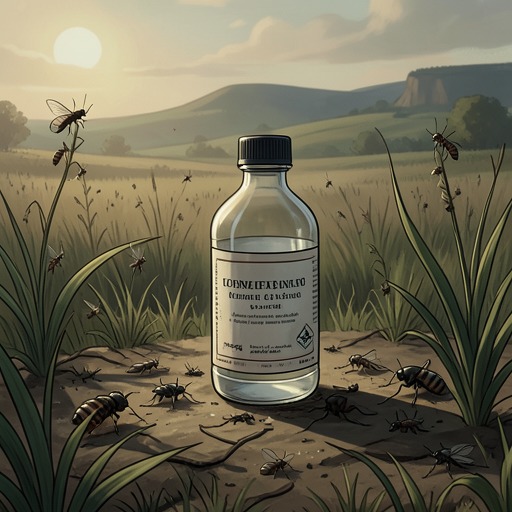
Chlordane
Silent SpringChlordane is a chlorinated hydrocarbon insecticide whose risks, as presented in Rachel Carson’s account, arise not only from its toxicity but from its persistence and multiple routes into the body. It can remain in the environment for years, enter through skin, inhalation, or swallowed residues, and accumulate in fatty tissue. Its profile makes it a concrete example of a wider problem: exposure can be gradual and cumulative, while the consequences of persistent chemicals and mixtures are difficult to predict.
A persistent environmental residue
Carson describes Chlordane as possessing the troubling characteristics of DDT, along with additional properties of its own. Its residues persist in soil, on foodstuffs, and on treated surfaces. The persistence is measured in years rather than months: Chlordane was recovered twelve years after application, with 15 percent of the original quantity still present. That interval turns a pesticide application into a long-lived environmental condition, rather than a brief intervention whose effects end when spraying stops.
The evidence places this persistence alongside that of other chlorinated hydrocarbons. Toxaphene remained in sandy soil ten years after application in sufficient quantity to kill termites; benzene hexachloride persisted for at least eleven years; and heptachlor or a more toxic derivative was found at least nine years later. Chlordane’s twelve-year recovery underscores how residues can outlast the immediate purpose for which a chemical was applied and remain available for subsequent exposure.
Routes of exposure and accumulation
Chlordane can enter the body through several routes. It may be absorbed through the skin, inhaled as spray or dust, or taken in through the digestive tract when residues are swallowed. The range of routes matters because exposure is not confined to a single setting or activity: residues on food and surfaces, as well as airborne material, can all contribute.
Like other chlorinated hydrocarbons described in the book, Chlordane accumulates in the body. A diet containing as little as 2.5 parts per million could eventually lead to storage of 75 parts per million in the fat of experimental animals. The contrast between dietary concentration and stored concentration makes cumulative exposure legible: a low level in food does not necessarily mean a low level in the body over time. Carson’s account connects such accumulation to the broader concern that persistent chemicals may be stored and only slowly excreted.
That broader discussion identifies fatty tissues and organs as important sites of DDT storage, and warns that even the smallest intake may contribute to continued accumulation until higher levels are reached. The book uses this pattern to explain why chronic exposure cannot be assessed solely by considering the amount encountered on a single occasion. For Chlordane, the experimental-animal figure gives that general concern a specific measure, without establishing an equivalent human outcome.
Chemical mixtures and uncertainty
Carson places Chlordane’s properties within a larger warning about pesticide exposure: people are not ordinarily exposed to one chemical under controlled laboratory conditions. Chemicals from different insecticide groups, and chemicals encountered alongside them, can interact. The book notes that Food and Drug Administration scientists found that simultaneous administration of malathion and certain other organic phosphates produced poisoning as much as fifty times more severe than an effect predicted by simply adding the substances’ separate effects. This is evidence about chemical mixtures, not a specific test of Chlordane, but it clarifies why an account of any one pesticide’s exposure cannot by itself describe the risks of combined exposure.
The text also distinguishes acute poisoning from the longer-term problem. A sufficiently large single exposure can precipitate acute poisoning, but Carson identifies cumulative and chronic effects as a major concern. In the case of Chlordane, its persistence, multiple entry routes, and accumulation in experimental animals together make repeated or continuing exposure central to the account. The evidence establishes these hazards and their mechanisms of exposure; it does not specify a human disease outcome attributable to Chlordane.
Use and significance
Chlordane appears not only in the discussion of environmental persistence and bodily accumulation but also among poisons in lawn preparations. Carson observes that crabgrass killers marketed under trade names that did not reveal their contents could include mercury, arsenic, and Chlordane. At recommended application rates, these products could leave substantial quantities of chemicals on lawns. The example brings the pesticide from agricultural and scientific discussions into ordinary household use, where a product’s name might conceal the nature of its ingredients.
Taken together, these details define Chlordane’s significance in the book: it is a persistent chemical encountered through ordinary environments and multiple exposure routes, with the capacity to accumulate in experimental animals over time. Its twelve-year persistence and the increase from 2.5 parts per million in diet to 75 parts per million in animal fat give concrete form to Carson’s concern that a pesticide’s effects cannot be understood by looking only at the moment of application or the apparent smallness of a single dose. The broader warning is about long-lived residues and cumulative exposure, compounded by the possibility that chemicals may interact.